Pro Locksmith – Seattle Commercial Locksmith
Pro Locksmith
Top Rated Commercial Locksmith Services Bonded & Insured
Serving The Greater Seattle Metro Area 24 Hours Every Day

Locksmith Services for Businesses, Offices and Buildings
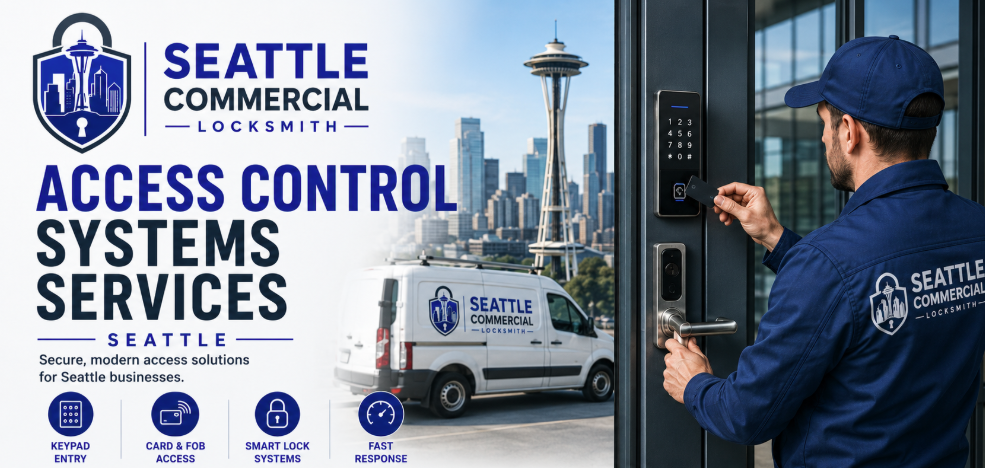
Access Control Systems for Modern Businesses
Metal keys are still useful, but some businesses need more control over people who can enter their premises. With commercial access control systems, you can allow employees to open doors with key cards, fobs, keypad codes, cell phones, or biometrics.
With such systems, you can make the entrance into your office safer, more convenient for your employees, and track when doors are opened. Such a system would fit well for an office building, warehouse, clinic, apartment building, retail store, school, and any other commercial property.
Your commercial access control system can cover just one door or an entire building.
Types of Commercial Access Control Systems
With keypad access control, employees need to enter a numeric code. Such systems are often used on office doors, storage rooms, employees entrances, and utility rooms. Numeric codes are easy to change when someone quits his or her job or if there is any concern about security.
Card and key fob access systems require electronic credentials assigned to every employ individually and with such a system, any management can enable or disable access for each user separately without changing the door lock.
With mobile access, authorized employees can open doors using a special app on a smartphone or using digital credentials. Mobile access is useful for business operating several properties or needing to grant access for a limited period.
With biometric access control, employees can access doors using their fingerprints or facial recognition, this system might be useful in case of highly restricted access, but you should pay attention to installation costs and privacy requirements.
Control Over Employees’ Access
Probably the greatest benefit of access control system is the possibility of setting different permissions. Receptionists can access the front office, while managers can also enter storage, administrative or equipment rooms.
Employees’ access can be controlled by time. For example, cleaning crew can enter your property only during prearranged evening hours. Your employees will be restricted from entering the building on weekends unless you give a special authorization.
Once an employee leaves the company, his or her access can be easily disabled. There is no need to collect all physical keys or rekey all doors.
Recording Access Attempts
Many access control systems log the date and time of entry attempts, door used and the credential that was employed to access a door. Such information is helpful for investigation, tracking of after hours activities, or verification of who accessed a restricted area.
Such audit information can be useful for meeting internal or industry security standards. You should be careful with such records because they should be stored according to privacy and data retention laws. Entry logs do not replace video monitoring or alarm systems, but give additional useful security information.
Hardware for Access Control Systems
Access control system requires such elements as card readers, keypads, electric strikes, magnetic locks, request to exit devices, door position sensors, power sources, control panels, and management software.
Depending on the door and building structure, you will need different hardware. Such doors as glass storefront doors, metal doors, fire doors, interior office doors, and exterior gates require different locking devices.
Life safety laws are particularly important. Your employees and guests need to be able to leave the building safely during an emergency. The proper functioning of panic bars, fire alarms and access controlled doors are required. A commercial locksmith will help you to install the locking hardware that complies with life safety laws and does not impede the process of emergency exit.
Standalone and Networked Access Control Systems
Standalone access control system manages doors independently from other systems. Such system might be useful for a small office, a supply room, and employees entrance.
When it comes to networked systems, all the doors are linked with a central management system. Managing users, user permissions and activities related to access would be done from one place. Remote management facilities are also offered by some systems along with video surveillance and other security features like intercoms and alarms.
Cloud based access control might be convenient for businesses having several locations. But your company should take into account such factors as internet reliability, cyber security, subscription fees, and access control.
System Maintenance and Updates
Access control systems need regular maintenance. Readers, batteries, door closers, electric strikes, sensors and other elements can fail or get out of order. Regularly review your software and permissions.
Your company should delete inactive credentials, change administrator password and check backup power system. Access control failure can result either in lockout or open door, so you should fix problems fast.
Expert Access Control System Installation
Commercial locksmith will inspect your premises, identify vulnerable doors and recommend an access control system which suits your needs and budget.
The right access control system can decrease the use of traditional keys, improve accountability and give business owner better control over building access.